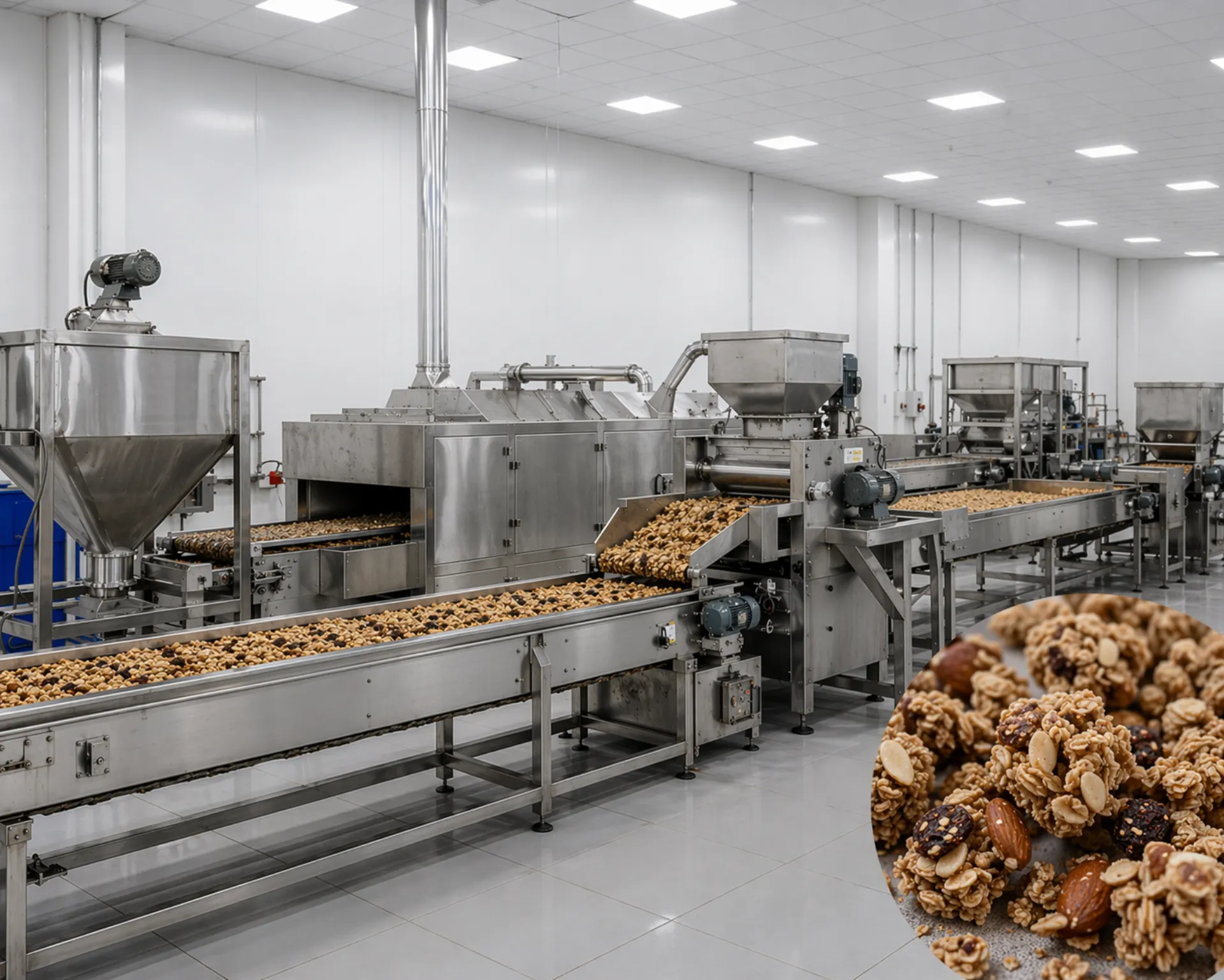
The process begins with mixing oats, nuts, seeds, and natural sweeteners such as honey or syrup to form a balanced granola mixture. The blend can then be baked or roasted in controlled conditions to create crunchy clusters with rich flavor and toasted aroma.
After baking, the product is cooled and gently broken into granola clusters of desired size, which can be used as breakfast cereal, yogurt toppings, or healthy snack mixes.
Natural flavors, spices, and nutritional additives
Granola Production Process
1. Raw Material Handling & Dosing
Accurate weighing and automatic dosing of raw materials ensure consistent recipes and production efficiency. Ingredients are transferred precisely according to pre-set formulations.
2. Mixing System
All ingredients are blended in a high-performance mixing unit to ensure homogeneous distribution of oats, nuts, seeds, and sweeteners.
3. Cooking / Baking Section
The mixture is baked in a continuous tunnel oven under controlled temperature and airflow, ensuring perfect texture, crispness, and caramelization.
4. Cooling Conveyor
The baked granola is cooled gradually to stabilize structure and prevent moisture formation.
5. Crushing & Clustering System (Optional)
Depending on product type, the baked sheet is broken into granola clusters or smaller cereal pieces.
6. Add-on Ingredient Application
Additional ingredients such as dried fruits, chocolate chips, or natural flavorings can be added after baking for product differentiation.
7. Screening & Quality Control
Sieving and quality control systems ensure uniform particle size and remove unwanted fines.
8. Packaging Integration
The final product is transferred to automatic weighing and packaging systems for sealing and long shelf life.